When a trusted computer starts slowing down, hanging on web pages, or taking minutes just to load the desktop, the immediate instinct for most consumers is to head straight to a big-box retail store to buy a replacement. It is a natural reaction. We live in an era where technology is marketed as disposable. You walk into the store, and for roughly £400 to £600, you can walk out with a brand-new, entry-level laptop. It looks shiny, it smells new, and it solves your immediate problem.
But as someone who has been dismantling, analyzing, and rebuilding computing hardware since the era of the Sinclair ZX80, I have to ask you to pause and consider a critical question: Is buying a budget replacement actually a good investment? Let's take a deep dive into the true Return on Investment (ROI) of hardware triage compared to buying new.
The "Budget Tech" Trap
To understand the value of what you currently own, we must first look honestly at the modern entry-level market. To hit that attractive £400 to £600 price point in 2026, manufacturers have to make massive compromises. These modern budget machines are often constructed entirely of flexible plastics. They feature low-resolution, low-brightness screens that strain the eyes, incredibly cramped keyboards with minimal travel, and internal cooling fans that sound like hair dryers under load.
Worst of all, they are frequently "sealed systems." The RAM and storage are permanently soldered to the motherboard. You cannot upgrade them. If one component fails, the entire laptop is useless. They are, unfortunately, electronic waste waiting to happen. Within two to three years, these machines frequently suffer from snapped plastic hinges, failing batteries, and processors that simply cannot keep up with basic software updates.
The Golden Era Survivor
Now, let us contrast that with the machine currently sitting on your desk. If you own an aluminum-clad Apple iMac from 2015, a Lenovo ThinkPad T-Series, an HP EliteBook, or a sturdy Dell OptiPlex tower, you own a Professional-Grade Survivor.
You originally paid well over £1,200 to £2,000 for these machines, and that money went into exceptional engineering. You paid for a magnesium-alloy skeleton. You paid for a spill-resistant, tactile keyboard. You paid for a breathtaking 4K or 5K Retina display covered in precision-milled glass. Apple and PC manufacturers from this "Golden Era" (roughly 2012 to 2019) were in a fierce race to build the ultimate, indestructible workstation. They built machines with heft and soul.
The tech industry might tell you these machines are "obsolete" because they don't meet the newest software requirements out of the box. But the hardware itself—the multi-core i5 and i7 processors, the robust cooling, the stunning glass—is phenomenal.
The Triage Math: Refurbish vs. Replace
Let's look at the cold, hard mathematics of Return on Investment.
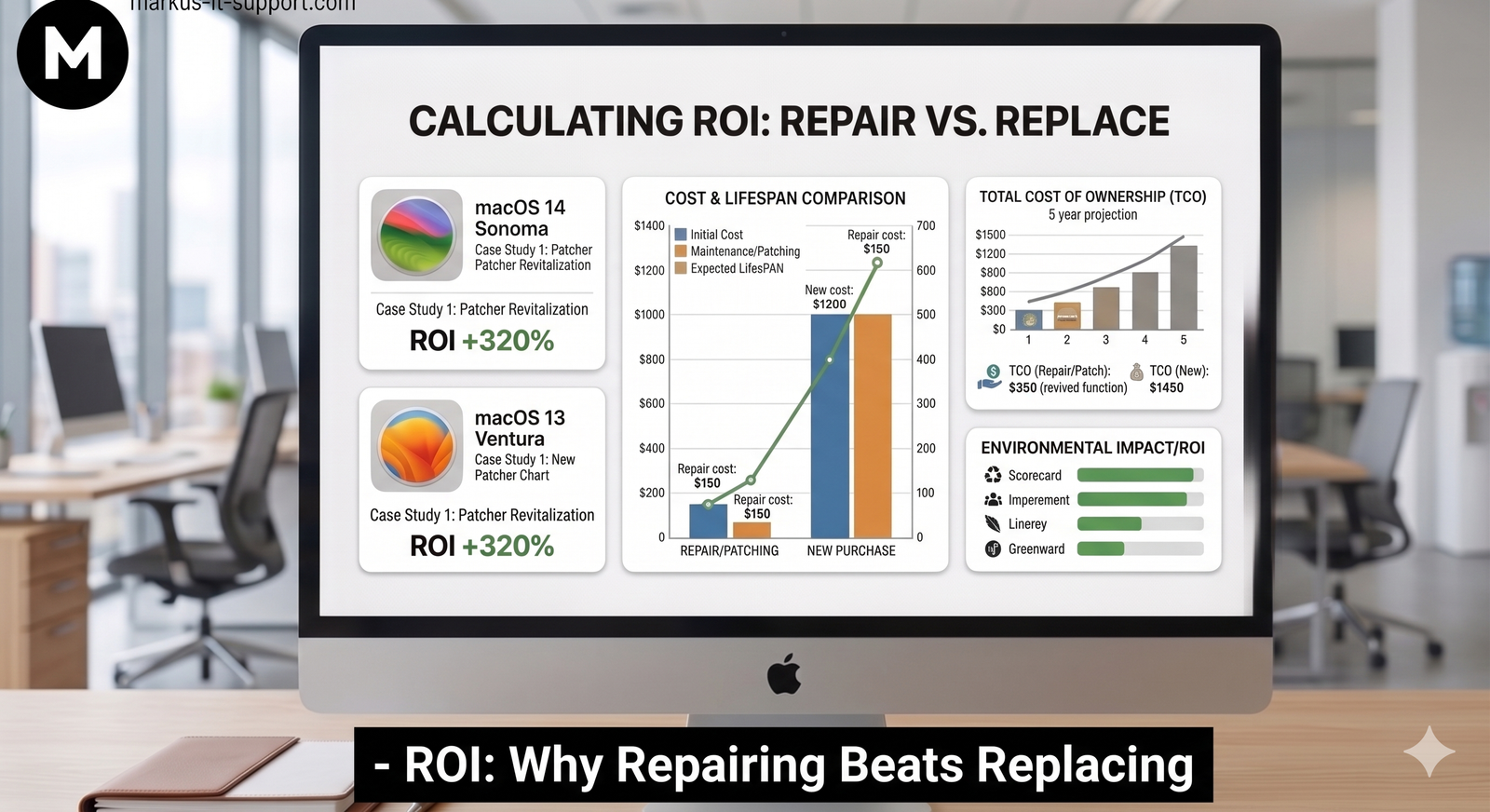
If you abandon your older professional machine, you will spend at least £500 on a budget replacement that will likely only last three years. That is an annualized cost of roughly £166 per year, not including the frustration of using a substandard screen and keyboard.
Alternatively, consider a Markus IT Rescue. For a fraction of the cost of a new machine—typically between £150 and £250—we can perform a comprehensive hardware and software overhaul.
- The SSD Engine: We extract the failing, slow mechanical hard drive and install a lightning-fast Solid State Drive (SSD), bringing boot times down from minutes to mere seconds.
- Thermal Refresh: We deep-clean the chassis and apply premium thermal paste, allowing the processor to run at maximum speed without overheating.
- OS Modernization: We utilize brilliant professional deployment tools to securely install modern macOS or Windows 11, bridging the gap between your sturdy hardware and today's security standards.
By investing £200 into a machine you already own, you are effectively buying yourself another 4 to 5 years of fast, reliable, professional-grade computing. That is an annualized cost of just £40 to £50 per year.
The Environmental Return on Investment
Beyond the financial savings, the environmental ROI is staggering. The manufacturing of a single new computer requires the mining of precious metals, vast amounts of clean water, and generates a massive carbon footprint. Simultaneously, disposing of your old computer adds toxic batteries and heavy metals to global landfills.
When you choose to refurbish and upgrade your classic hardware, you are actively participating in the circular economy. You are proving that incredible engineering deserves a second act. You are drastically reducing your personal e-waste footprint.
The Final Verdict: Service the Engine
The "Modular Truth" of computing is that professional hardware from the last decade was built to be serviced, not discarded. Your machine isn't dead; it is simply suffering from an outdated mechanical hard drive or a strict OS lock that can be easily bypassed by an expert.
Do not throw away £1,500 worth of premium aluminum and glass just because the manufacturer wants to sell you a plastic replacement. You aren't just saving money by repairing; you are retaining a machine that is structurally superior and often significantly faster than the entry-level replacements on the market today. Service the engine; don't replace the car.
Further Reading & Resources
- Markus IT Intel: The Software Wall - Don't Throw It Away! →
- Markus IT Intel: Classic Hardware vs Modern Disposables →
- External Insight: The Right to Repair Movement (iFixit) ↗